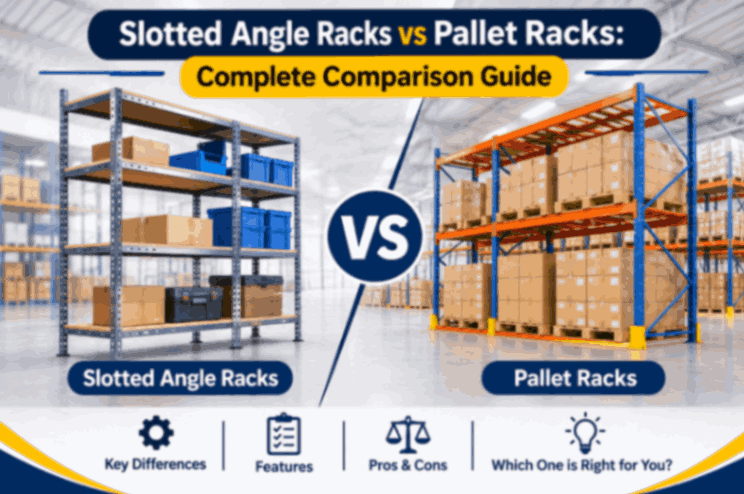
Most storage projects start with one practical question: shelves or pallets? If you are weighing Slotted Angle Racks against pallet racking, the right answer depends on three things: what you store, how it moves in and out, and how much weight each level must carry. A wrong choice costs money either way. You either pay for heavy-duty racking and forklifts that you never needed, or you load shelves that were never built for your stock.
This guide compares slotted angle racks vs pallet racks side by side. You will see how each system works, how they differ in load, cost, space, flexibility, installation and safety, and which one suits your business. Use it as a checklist before you place an order.
The Short Answer
Slotted angle racks suit goods that people lift by hand: cartons, tools, spare parts, files and loose stock. They cost less, need no machinery and can be rebuilt as your needs change. Pallet racks suit goods stored on pallets and moved by forklift or pallet truck. They carry far heavier loads and make better use of large, tall warehouses. Together, they work well in a mixed warehouse: pallet racks for bulk reserve stock, slotted angle racks for picking small items. The sections below explain the reasons so that you can test the answer against your own situation.
Slotted Angle Racks at a Glance
A slotted angle rack is built from steel angle sections that have evenly spaced slots. Nuts, bolts and shelves join the angles into uprights and shelf levels. The slots let you raise or lower shelves, resize the rack and reuse the same parts in a new layout.
Because people load them by hand, they work best for items that one or two people can lift. Typical uses are:
Cartons and packaged goods in stockrooms and retail backrooms
- Tools, accessories and spare parts in workshops and factories
- Files, records and stationery in offices and archives
Capacity depends on the model, the angle thickness, the shelf span, and whether the rating is per shelf, per level, or for the whole unit. Our listed models range from about 50 kg to 250 kg per shelf or level, depending on the design.
Pallet Racks at a Glance
A pallet rack is a heavy-duty frame made of uprights and horizontal load beams. Each beam level holds pallets, which a forklift, stacker or pallet truck lifts into place. Bay width, beam length and level height are planned around standard pallet sizes.
The most common layouts are:
- Selective racking: every pallet is directly reachable, which suits many different products.
- Drive-in and drive-through racking: forklifts enter the rack, so many pallets of one product fit in a small footprint.
- Push-back racking: pallets slide back on inclined rails, which increases storage density.
- Pallet racks are rated for much heavier loads than shelving. The rating is usually stated per beam level or per bay, depending on the beam and upright design.
Side-by-Side Comparison
Factor | Slotted angle racks | Pallet racks |
| Built for | Cartons, tools, parts and general goods | Palletised bulk loads |
| How you load | By hand | Forklift, stacker or pallet truck |
| Load per level | Light to medium (tens to a few hundred kg) | Medium to very heavy (hundreds of kg to several tonnes, by design) |
| Layout flexibility | High: adjustable shelves, easy to rebuild | Moderate: beams adjust, but the layout follows the pallet |
| Upfront cost | Lower | Higher, plus handling equipment |
| Equipment needed | None | Forklift or pallet truck |
| Aisle width | Narrow aisles work | Usually wider aisles for machinery |
| Installation | Simple bolted assembly | Planned layout, levelling, often anchoring and trained installers |
| Best for | Offices, shops, workshops, stockrooms, small and mid-size warehouses | Large warehouses, distribution and manufacturing units |
| Picking | Easy for small and mixed items | Easy for full pallets, harder for loose items |
These are general ranges. Always confirm the rated capacity of the exact model and configuration before you buy.
How They Differ in Practice
Load Capacity
Load is usually the deciding factor. Slotted angle racks carry light to medium weights that people lift by hand. Pallet racks are engineered for heavy, concentrated loads such as full pallets.
A simple test works well: if each item weighs a few kilograms and you place it by hand, shelving is enough. If you store full pallets that weigh hundreds of kilograms or more, you need pallet racking. Also check how a rating is stated. A
figure per shelf is not the same as a figure for the whole rack, so never multiply a shelf rating by the number of shelves unless the manufacturer confirms it.
Handling and Equipment
A slotted angle rack needs only a person. A pallet rack needs a forklift, stacker or pallet truck, plus a trained operator and regular machine maintenance. When you compare prices, add these running costs to the pallet rack side.
Flexibility and Layout Changes
Stock changes, products change, and rooms change. Slotted angle racks handle this well because you can move shelves, add levels, change the width and reuse the parts elsewhere. That is why small businesses and fast-changing stores like them. If flexibility is your priority, our Slotted Angle Racks Guide explains the sizes, adjustable shelf options and rack configurations in detail.
Pallet racks allow beam height adjustment, but the design follows pallet dimensions. Changing the layout takes more planning and usually more labour.
Cost
Slotted angle racks cost less upfront and need no machines. Pallet racks cost more, and the total grows once you add forklifts, wider aisles and installation. On the other hand, when you store large volumes of heavy palletised stock, pallet racks can be the more economical choice per pallet.
For both systems, price depends on size, steel thickness, finish and quantity. Compare quotes for the same load requirement, not for rack types in general.
Space Use
Slotted angle racks fit small rooms and narrow aisles, and they use vertical space well in compact areas. Pallet racks shine in large, tall warehouses, where they stack heavy pallets high and in dense layouts, but they usually need wider aisles so equipment can turn.
Installation
Slotted angle racks come with nuts, bolts, and basic tools, so most teams assemble them by following the instructions. Pallet racks use heavy parts that must be aligned and often anchored to the floor, so a trained team should install them.
Safety and Maintenance
Both systems must stay within their rated loads. On slotted angle racks, inspect bolts, shelves and frames for bending, damage or rust, and spread weight evenly. On pallet racks, inspect uprights and beams often, because forklift impact commonly causes damage. Take any damaged section out of service until it has been checked.
Picking and Access
Shelves suit hand picking, so slotted angle racks work well for small items, tools, and cartons. Pallet racks suit picking whole pallets. Loose items on a pallet rack are harder to reach, so many warehouses add shelving for small-item picking.
Which Rack Fits Your Situation?
Pick slotted angle racks when:
- your goods are light to medium, and you lift them by hand
- you want a lower upfront cost and no forklift
- your stock sizes change, and you need adjustable shelves
- your space is small, or the aisles are narrow
- you want a rack you can assemble yourself and rebuild later
Pick pallet racks when:
- your goods arrive and leave on pallets
- your loads are heavy and bulky
- you already run, or plan to buy, a forklift or pallet truck
- your warehouse has enough height and aisle space
- you need high-density storage for large volumes
Which Rack for Which Business?
Business | Typical goods | Better fit |
| Retail store backroom | Packaged goods, cartons | Slotted angle racks |
| Office or archive | Files, records, stationery | Slotted angle racks |
| Workshop | Tools, accessories, small parts | Slotted angle racks |
| Factory spare parts room | Parts and components | Slotted angle racks |
| Distribution centre | Full pallets | Pallet racks |
| Raw material store | Heavy bulk material on pallets | Pallet racks |
| Mixed warehouse | Pallets plus small items | Both: pallet racks for bulk, slotted angle racks for picking |
Can You Use Both Together?
Yes, and many warehouses do. Pallet racks hold bulk reserve stock, while slotted angle racks form a pick area where staff take single cartons and small parts by hand. You get dense storage for heavy goods and fast, low-cost access for smaller items.
Mistakes to Avoid
- Choosing by price alone. A cheap rack that cannot carry your load is the most expensive option.
- Ignoring the load rating. Overloading can damage racks and cause accidents.
- Skipping the space check. Measure floor area, ceiling height and aisle width, and allow turning room if you use a forklift.
- Buying pallet racks for hand-loaded goods. You pay for strength and machinery that you will not use.
- Using shelving for heavy pallets. Slotted angle racks do not replace pallet racking under heavy pallet loads.
- Forgetting growth. Think about how your stock and space may change in the next few years.
A Six-Question Checklist
1. What do you store? Loose items and cartons point to slotted angle racks. Pallets point to pallet racks.
2. How much must each level hold? Light to medium points to slotted angle racks. Heavy points to pallet racks.
3. How will you load it? By hand points to slotted angle racks. By forklift points to pallet racks.
4. How much space do you have? Compact rooms suit slotted angle racks. Large, tall halls suit pallet racks.
5. What is the full budget? Include equipment, installation and aisle space, not only the rack.
6. Will the layout change? Frequent change favours slotted angle racks.
If you are still unsure, share your goods, weights, room dimensions and handling method with your supplier and ask for a recommendation based on those details.
Frequently Asked Questions
Q. What is the main difference between slotted angle racks and pallet racks?
Slotted angle racks are adjustable shelving that people load by hand, suited to light and medium goods. Pallet racks are heavy-duty racking for palletised loads handled by a forklift or pallet truck.
Q. Which is cheaper?
Slotted angle racks usually cost less upfront and need no handling equipment. Pallet racks cost more, and the total includes forklifts and wider aisles.
Q. Which holds more weight?
Pallet racks are designed for heavier loads. Slotted angle rack capacity depends on the model, thickness and shelf span, so check the rated capacity before loading.
Q. Can I use slotted angle racks in a warehouse?
Yes, for cartons, spare parts and other goods handled by hand. For full pallets, use pallet racks.
Q. Do slotted angle racks need a forklift?
No. People load and unload them by hand.
Q. Are slotted angle racks adjustable?
Yes. The slotted sections and bolted joints let you change shelf heights and rebuild the rack in a different layout.
Which is easier to install?
Slotted angle racks, because they use a simple bolted assembly. Pallet racks need careful alignment and are usually installed by a trained team.
Q. Can I combine both in one storage area?
Yes. Use pallet racks for bulk pallets and slotted angle racks for a picking area with small items.
Which is better for a small business?
Many small businesses that store cartons, tools or stock by hand are well served by slotted angle racks, thanks to the lower cost and flexibility.
Conclusion
The choice between slotted angle racks vs pallet racks comes down to what you store, how you handle it, and how much space and budget you have. Slotted angle racks give you flexible, lower-cost storage for goods you lift by hand. Pallet racks give you heavy-duty, high-density storage for pallets moved by forklift. Many businesses get the best result by using each where it fits.
Before you decide, confirm the load rating, dimensions and configuration for your exact needs. Then contact Sisco Steel Products with your storage requirements, and we will recommend the right rack for your space and stock.