
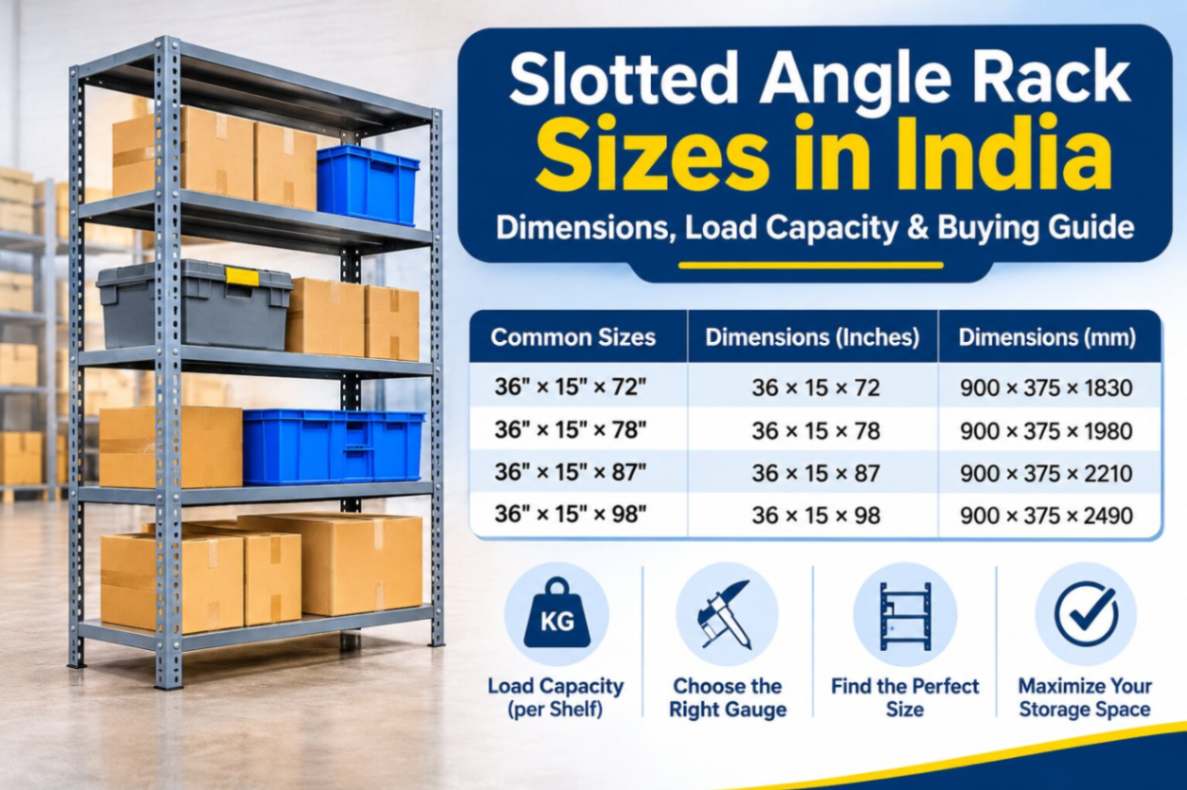
- Seller listings in India keep repeating the same footprint: 36 in (900 mm) long and 15 in (375 mm) deep.
- Heights of 72 to 78 in (approx 1830 to 1,980 mm) will fit most stockrooms and offices.
- Two racks of the same size can carry very different loads. Check the gauge of the angle and shelf.
- Depth determines how much floor you lose. Length and gauge determine how much each shelf can hold.
Slotted Angle Rack Sizes Chart
| 24 × 36 × 15 | 610 × 915 × 380 | 2 |
| 36 × 36 × 15 | 915 × 915 × 380 | 3 |
| 60 × 36 × 12 | 1,525 × 915 × 305 | 5, 7 |
| 72 × 36 × 15 | 1,830 × 915 × 380 | 3 to 7 |
| 78 × 36 × 15 | 1,980 × 915 × 380 | 4, 6, 8, 9 |
| 87 × 36 × 15 | 2,210 × 915 × 380 | 4, 6, 7, 9 |
| 98 × 36 × 15 | 2,490 × 915 × 380 | 4 to 9 |
Metric Sizes and Inch-to-mm Conversion
| 12 | 305 | 300 |
| 15 | 381 | 375 |
| 18 | 457 | 450 |
| 24 | 610 | 600 |
| 36 | 914 | 900 |
| 48 | 1,219 | 1,200 |
| 78 | 1,981 | 1,980 |
What Each Dimension Means
- Length (shelf width): 36 " (900 mm) is the most common, 45 " (1,200 mm) is also available. The longer the shelf, the more it will bend if you put the same load on it; hence, they will generally require thicker steel.
- Depth: the majority of shelves are between 12" and 24" deep (300mm to 600mm). Measure your largest item and select a shelf that will accommodate it with nothing overhanging.
- Height: the small racks start at around 24", and the tall ones can go up to 98" or more. Before you go any further, check your ceiling height and allow for space for the lights, sprinklers and any beams.
- Shelves and spacing: the more shelves you add, the less space you have between them. A 72" rack with 5 shelves gives you about 14" per shelf (before you get right down to the space under the bottom shelf). You can move the shelves around later as there are slots.
- Floor clearance: Some of the racks have around 3 inches (75 mm) of space under the bottom shelf.
Gauge, Angle Size and Load: Why Size Alone Is Not Enough
| 20 | 1.0 mm |
| 18 | 1.2 mm |
| 16 | 1.5 mm |
| 14 | 2.0 mm |
| 12 | 2.5 mm |
| A | Not stated, 5 shelves, 72 in high | About 25 to 50 kg per layer |
| B | 22 gauge shelf, 16 gauge angle | 60 kg per shelf |
| C | 1.2 mm shelf, 2 mm angle | 100 kg per shelf |
Worked Example: Sizing a Rack for Cartons
Depth: a 15" deep shelf will hold one carton with plenty of room to spare.
Length: a 36" shelf will hold 3 cartons side by side (36kg per shelf).
Margin. Add 25%. Plan on approximately 45kg per shelf. The 20 to 30% margin is a rule of thumb from the seller's guides, not a standard.
Spacing: cartons need 10 in plus 2 to 4 in for your hands, so 12 to 14 in per level.
Frame. A 72" rack with 5 shelves gives you about 14" per level.
Ask for: 15 x 36-inch shelves rated at 50kg or more per shelf (evenly spread), on a 72-inch frame with 5 shelves.
How to Choose the Right Size
Measure floor area, ceiling height (minus lights and sprinklers), aisle width, and the width of doors and lifts. Angles come up to 3 m long, so check how they will be carried in.
Weigh your heaviest shelf load and add a margin.
Pick depth from your deepest item and length from the load.
Ask for the datasheet: shelf and angle thickness in mm, load per shelf, how it was tested, and the finish.
Common Mistakes
- Choose by height only. Capacity is determined by length, depth and gauge.
- Read the shelf rating as total rack capacity. Check whether that's per shelf, per level or total.
- Ignore the overhang. Anything hanging past the edge of the shelf reduces the usable load.
- Mixing inches and mm without checking the rounding. 36" is 914mm not 900mm.
- Skip the gauge. 'Heavy duty' isn't a specification.
- Trust a standards claim without any paperwork. One slotted angle rack listing on the Government e-Marketplace states it is not made to BIS, another cites IS 1883. BIS now has IS 1883 marked as withdrawn and superseded by IS 17634:2022. There's no standard I can find that addresses slotted angle rack sizes, so you can just ask any seller what standard they claim and for a test report.
When Not to Use a Slotted Angle Rack
- Pallets or forklift loading. One seller has slotted angle shelves at about 200kg per shelf and state that their heavy duty frames can handle more.
- Loads close to or above the listed per-shelf rating. Move up to a heavier system instead of stacking more steel.
- Damp or corrosive areas without a suitable finish. Ask about galvanising or coating.
- Tall racks without anchoring. Follow the maker’s advice on fixing tall racks to a wall or floor
Conclusion
Faq
1. What is the standard size of a slotted angle rack?
2. What are the common slotted angle rack dimensions in mm?
Shelves are typically 900 or 1,200 mm long and 300, 375, 450 or 600 mm deep. One supplier lists rack heights of 1,980 mm, 2,130 mm and 2,450 mm. The exact dimensions will of course vary according to the manufacturer.
3. What size slotted angle rack is best for a warehouse?
Pick depth and length from your cartons and load, not from a fixed rule. Racks ranging from 78 to 98 in. with 15 to 24 in. deep shelves are available in the warehouse listings. Check the rating per shelf and don't use these racks for pallets.
4. How many shelves can a slotted angle rack have?
Listings show 2 to 9 shelves depending on the height. The more shelves you have the less space there is between them. A 72" rack with 5 shelves gives you about 14" per level.
5. What is the standard depth of a slotted angle shelf?
Listings typically offer 12, 15, 18, 21 and 24 in (approximately 300 to 600mm). 15in is by far the most common depth in the listings I've looked at. Choose the depth to suit your deepest item.
6. How much weight can a slotted angle rack take per shelf?
It's down to gauge, span and design. For similar sizes the listings will range from circa 25 to 50kg up to 100kg or more per shelf and the heavier builds will be quoted at the higher end. Always get the per shelf rating in writing.
7. What does 'gauge' mean in a slotted angle rack?
Gauge is steel thickness. The higher the number, the thinner the steel. One manufacturer's guide has 16 gauge at circa 1.5mm and 14 gauge at circa 2.0mm. Always ask for the thickness in mm.
8. What's the difference between the 15" and the 18" depth?
An 18" shelf is roughly 3" deeper than a standard shelf. That extra depth allows you to store larger items, but it also means it projects further into the room. Always check the weight capacity before you buy as the deeper shelf may require more robust steel to carry the same load.
9. Can slotted angle racks be made to custom sizes?
Yes the slotted system is modular and the manufacturers will cut the angles and shelves to size. Just give them your height, length, depth, number of shelves and the load per shelf.
10. How do I convert slotted angle rack sizes from inches to mm?
Multiply inches by 25.4. For example, 36 in × 25.4 = 914 mm, which sellers round to 900 mm. The slotted angle rack sizes chart above shows common rounded pairs.
11. Is there a BIS standard for slotted angle racks?
BIS lists standards for metal shelving racks, but IS 1883:2020 is now withdrawn and superseded by IS 17634:2022. I found no standard that fixes slotted angle rack sizes. Ask the seller which standard they claim and for a test report.
12. How far apart should shelves be?
Leave the height of your tallest item plus a few inches for hands. For 10 in cartons, 12 to 14 in per level works. The slots let you move shelves later, and one seller quotes 25 mm steps.