
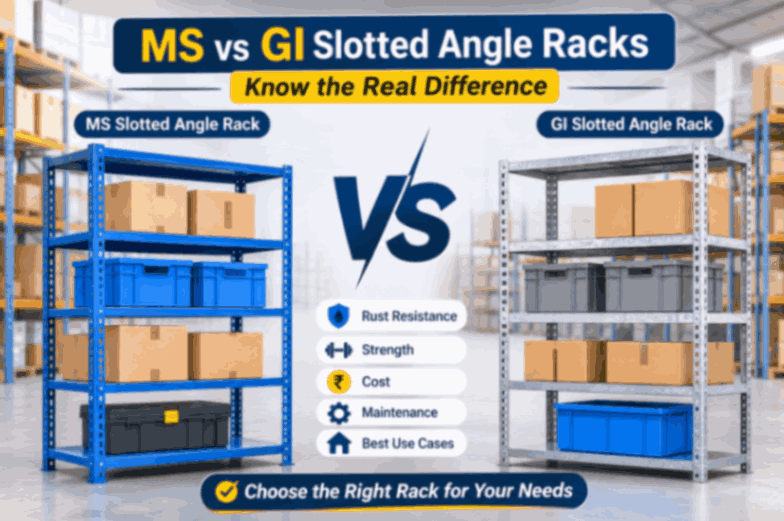
When you start looking at slotted angle racks, you’ll see two main types: MS and GI. Sellers don’t always explain what these mean, and the price difference can be confusing. Here, I’ll break down the real differences that matter to you—like rust resistance, strength, cost, and finish. I’ll also show you how to check what “GI” really means before you buy, since most listings skip that part.
Here’s the quick answer. MS racks (mild steel) cost less and usually come painted or powder-coated. They work well in dry indoor spaces. GI racks (galvanized) have a zinc coating, so they fight rust better in damp or coastal areas. The real strength comes from the thickness and design, not just the label. Pick the rack that fits your space and what you need to store. For a dry office or warehouse, a good MS rack is often fine. For damp or coastal spots, GI racks last longer. Always get the thickness and coating details in writing.
What Are Slotted Angle Racks Made Of?
Most slotted angle racks use steel angles with holes already punched in them. You bolt them together, then add the shelf panels on top. No welding is needed, so you can move shelves up or down or change the rack layout whenever you want.
In India, IS 8081:1976 is the standard titled “Specification for slotted sections”, and it was reaffirmed after a 2021 review. One technical summary notes that the standard’s original steel reference (IS 226) is obsolete and that the current equivalent is IS 2062, typically Grade E250. That summary is a secondary source, so confirm the grade with your supplier.
What decides how much a rack can carry? Load capacity depends on factors such as angle thickness, shelf design, rack size, and connections. Keep that in mind, because it's key to the MS vs GI question.
What Is an MS Slotted Angle Rack?
MS means mild steel. It’s a type of steel that’s easy to cut and shape. MS racks usually come painted, powder-coated, or sometimes black. Most sellers call them powder-coated in their listings.
Strengths: lower upfront price, wide availability, many colour options, good for dry indoor use.
Weak points: The steel under the paint or powder has no extra protection. If the coating gets scratched or chipped, water can reach the bare steel and rust will start from there.
What Is a GI Slotted Angle Rack?
GI stands for galvanized iron, but it really means steel with a zinc coating. The zinc layer protects the steel from rust. If the rack gets scratched, the zinc will usually corrode first and help keep the steel safe.
Here is what listings rarely explain. “GI” can be made in two different ways:
- Pre-galvanized (from GI sheet or coil): the strip is galvanized first, then slotted and cut into angles. IS 277:2018 covers hot-dip galvanized sheets and strips (coils). The cut ends and punched slots aren't fully covered by the original zinc layer, so rust usually starts at these edges.
- Hot-dip galvanized after fabrication: the finished angles are dipped in molten zinc, so slots and edges are coated too. This is typically the more corrosion-resistant option and usually costs more. In India, IS 4759:1996 covers hot-dip zinc coatings on structural steel and allied products. I couldn’t find out which method each supplier uses, so it’s best to ask before you buy.
MS vs GI Slotted Angle Racks: Side-by-Side Comparison
| Base material | Mild steel | Steel with a zinc coating |
| Corrosion protection | Paint or powder coating only | Zinc layer, sometimes plus paint |
| Rust risk if scratched | Higher: bare steel is exposed | Lower: zinc protects nearby steel |
| Best environment | Dry, indoor | Humid, coastal, damp, semi-outdoor |
| Strength and load | Depends on thickness and design | Depends on thickness and design |
| Upfront cost | Usually lower | Usually higher |
| Maintenance | Touch up scratches | Keep dry, check cut edges |
| Look | Many colours | Usually silver-grey |
On price: When I checked IndiaMART and TradeIndia in November 2026, MS slotted angle racks were about ₹60 to ₹90 per kg. GI racks were usually higher, around ₹95 to ₹110 per kg. Prices change with thickness, city, finish, and how much you order. Use these numbers as a rough guide, not a final quote.
The Difference Between MS and GI Slotted Angle Racks: 6 Factors That Matter
1. Rust resistance. This is the biggest difference. GI wins in moisture. MS can perform well indoors if the powder coating is even and undamaged.
2. Strength. A GI rack is not automatically stronger. The zinc layer is a thin coating on similar base steel. A 2 mm MS angle is not stronger than a 3 mm GI angle, and the reverse is also true. Compare thickness in mm, leg size (listings commonly show 40×40 mm, 60×40 mm, and 80×40 mm), shelf panel thickness, and shelf span. If you are still deciding on size and shelf count, read our guide on how to choose the best slotted angle racks.
3. Cost. MS is cheaper to buy. But in a damp place, GI might save you money over time because you won’t need to repair or replace it as often. Check the cost example below.
4. Maintenance. MS racks need touch-up paint if they get scratched. GI racks need less care, but you should keep them dry. If water gets trapped, the zinc can get white rust.
5. Appearance and hygiene. MS racks can look neat and colourful, which is good for shops and offices. GI racks have a plain metal look, so they fit better in storerooms or utility areas.
6. Availability and customization. You’ll find MS racks in more sizes and colours, and they’re usually in stock. GI racks, especially hot-dip ones, might take longer to get. Always check with your supplier.
Which Is Better, MS or GI Slotted Angle Rack?
There’s no one-size-fits-all answer. Use this table as a guide to help you choose.
| Dry office, store room, retail shop | MS, powder coated |
| Dry, ventilated warehouse | MS powder coated, with a thicker section for heavier loads |
| Humid area or coastal city | GI, hot-dip preferred |
| Cold storage, condensation, damp basement | GI |
| Semi-outdoor shed or open yard | GI, ideally hot-dip; MS only with a repaint plan |
| Heavy loads | Choose by thickness and design first, then coating |
| Tight budget, short-term use | MS |
When NOT to Choose Each One
Don’t pick MS if your space is damp or near the coast, if the rack will get washed or wet, or if you can’t repaint scratches.
Don’t pick GI if you want a special colour finish, your space is dry, or you need to save money. Also, don’t pay extra just because you think GI is always stronger. It isn’t.
A Simple Cost-of-Ownership Check
Use this formula with your own quotes:
Yearly cost = (purchase price + repair or repaint cost + replacement cost) ÷ years of use
Here’s a simple example. If an MS rack costs ₹3,000 and you need to replace it after 5 years in a damp store, that’s ₹600 a year. If a GI rack costs ₹3,800 and lasts 10 years, that’s ₹380 a year. In a dry room, the MS rack might last just as long, so it could be the better deal.
Buyer’s Checklist: Ask Before You Pay
- Thickness and leg size in mm, not just “heavy duty.”
For GI: is it pre-galvanized or hot-dip galvanized after fabrication? Ask for the coating mass in g/m². BIS testing for IS 4759 covers zinc coating mass, uniformity, and adhesion.
For MS: ask about surface cleaning before coating and the powder coat finish.
Nuts and bolts: are they galvanized or zinc-plated? Bare bolts rust first.
Ask about load per shelf (stated as evenly spread weight) and shelf panel thickness.
Angle quality: straight, clean slots, no sharp burrs.
Warranty in writing.
How to Pick a Reliable Storage Racks Manufacturer
No matter which type you pick, the storage racks manufacturer is just as important as the metal. A good supplier will tell you the angle thickness, coating method, and load per shelf right away, and put it in the quote. Ask to see a sample or photos of past work. Make sure the bolts and shelf panels match the frame. If a supplier dodges your questions, that’s a red flag.
Common Mistakes Buyers Make
- Assuming GI means stronger.
- Buying only on price per kg without comparing thickness.
- Not asking how the GI was made.
- Mixing bare bolts with a coated frame.
- Overloading one shelf or stacking weight unevenly.
- Choosing MS for a damp area to save a little money.
Care and Maintenance
For MS racks, fix chips and scratches fast and keep the base dry. For GI racks, keep them dry too and watch out for water getting trapped. If you cut or drill the rack, use zinc-rich paint on the edges. Tighten the bolts now and then, and don’t overload the shelves. If you need to cut or weld on site, make sure the area is well-ventilated, since heating zinc can give off fumes.
Before you order, tell your supplier your room size, how many shelves you want, and how much weight each shelf needs to hold. This helps them suggest the right thickness and finish for you.
Frequently Asked Questions
What is the difference between MS and GI slotted angle racks?
MS racks use mild steel with a paint or powder-coat finish. GI racks use steel with a zinc coating. The main practical difference is rust resistance, especially in damp or coastal places.
Which is better, an MS or GI slotted angle rack?
It depends on where you use it. MS suits dry indoor spaces and tighter budgets. GI suits humid, coastal, or semi-outdoor use. Load capacity depends on thickness and design for both.
Is a GI slotted angle stronger than MS?
Not by itself. Zinc is a protective coating, not a strength upgrade. Compare angle thickness, section size, and shelf design.
Do GI slotted angle racks rust?
They resist rust much longer, but they can still corrode at cut edges, scratched spots, or where water stays trapped. Hot-dip galvanizing after fabrication protects edges better than pre-galvanized strip.
Is an MS slotted angle rack good for a warehouse?
Yes, in a dry, ventilated warehouse, if the powder coating is even and the thickness suits the load. In humid or coastal sites, GI is usually the safer choice
Are GI slotted angle racks more expensive?
Usually, yes. Marketplace listings I checked showed GI at a higher per-kg price than MS, though prices vary widely by thickness and supplier.
How long do slotted angle racks last?
There is no single number. Life depends on the environment, coating quality, load, and maintenance. Get the coating and thickness details in writing.
Conclusion
Choosing between MS and GI racks is really about your environment, not just the label. Go with MS for dry indoor spaces if you want to save money. Pick GI if you’re dealing with moisture, coastal air, or dampness. For both, always check the thickness, coating, fasteners, and load per shelf before you buy.