
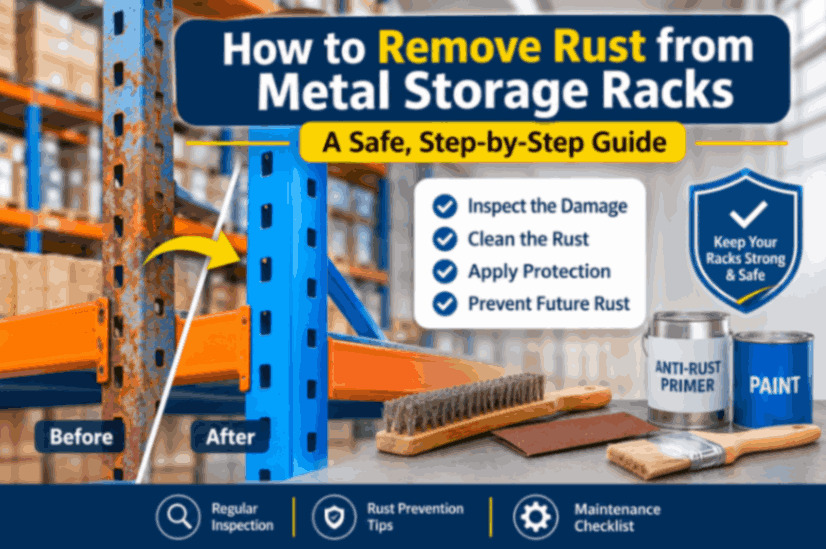
1. Is it rust you can clean, or rust you must replace?
2. Why storage racks rust in the first place
3. Safety and kit before you start
4. How to remove rust from metal storage racks, step by step
5. Which method suits which rack finish
6. Protecting the bare steel afterwards
7. Repair, replace or re-buy?
8. Common mistakes
9. Warehouse rack rust prevention: a maintenance routine
10. Choosing racks that resist rust
11. FAQ and References
1. Is it rust you can clean, or rust you must replace?
| Orange dust or light bloom, coating mostly intact, steel surface smooth | Around grade B | Surface rust | Clean, treat, touch up the coating |
| Flaking rust, blistered coating, steel feels smooth after brushing | Around grade B to C | Early corrosion, section still sound | Remove mechanically, treat, prime, repaint, re-inspect in a few weeks |
| Pits you can see or feel, layered scale, thinned edges | Around grade C to D | Steel is being lost | Stop loading that bay, get a competent person to assess |
| Holes, rust at the baseplate or beam connector, rust combined with bending or impact damage | Grade D | Structural risk | Unload and replace the component |
2. Why storage racks rust in the first place
3. Safety and kit before you start
- Unload and isolate the bay. Tape it off. Do not brush or grind under a loaded shelf.
- Protect yourself. Wear gloves, eye protection and a dust mask suited to the job. Add a respirator if you use solvent or acid products indoors, and ventilate the area.
- Read the safety data sheet (SDS) of every product. Never mix cleaners. Combining chemicals can release toxic gas.
- Old paint needs care. If the paint is old and you don't know what is in it, check before dry sanding or grinding. Older paints in some countries contained lead.
- Plan the waste. Rust dust, used wire wool and spent chemicals should be disposed of as your local rules and the product label direct.
- Kit list: soft brush, stiff nylon brush, wire brush or abrasive pad, mild detergent, clean water and cloths, rust remover or rust converter (if needed), rust-inhibiting primer, topcoat or touch-up paint, drop sheets.
4. How to remove rust from metal storage racks, step by step
Unload, tag and inspect. Triage using the table in section 1. Photograph each problem spot with a tape measure or coin for scale.
Dry-brush loose rust and dust. Start with a soft brush, then a stiff one. Work gently on edges.
Degrease and wash. Oil and grime stop treatments from reaching the rust. Use mild detergent and water, rinse, and let the rack dry completely.
Remove rust mechanically. Use a wire brush, abrasive pad or sandpaper. Brush the rust back to firm, sound metal, and feather the edge of the surrounding paint so the repair blends. Standards describe this kind of hand and power-tool
cleaning in St grades, where the aim is a surface free of loose rust and poorly adhering paint. Avoid grinding thin sheet. It removes metal quickly.
Use a chemical step only if needed. A gel rust remover clings to vertical frames better than a runny liquid. A rust converter reacts with firmly bonded rust and leaves a stable film you can paint over. Test on a hidden spot first, and follow the contact time on the label.
Rinse or neutralise as the label says, then dry fast. Bare steel can flash-rust within hours in humid air.
Prime straight away. Use a rust-inhibiting primer that suits your topcoat. Check the datasheet for recoat windows.
Topcoat or touch up. Match the colour as closely as you can. Field paint will not equal a factory powder coat, and it is
better to say so than to pretend otherwise.
Let it cure before loading. Cure times depend on product and humidity. The datasheet is your guide.
Record it. Note the bay, the damage, the fix and the date. Re-inspect the repaired spots after a few weeks.
5. Which method suits which rack finish
| Wire brush, abrasive pad, sandpaper | Light to moderate rust on frames, shelves and brackets | Thin sheet with deep pitting | Cheapest and most controllable. Dust control needed |
| Power wire wheel or flap disc | Heavy surface rust on thick sections | Thin shelf panels, galvanised areas you want to keep | Fast, but removes metal. Use light pressure |
| Gel rust remover (acid-based) | Vertical frames, joints, awkward corners | Galvanised or painted areas you want to keep | Follow contact time and rinse instructions on the label |
| Rust converter | Firmly bonded surface rust that cannot be fully removed | Loose, flaking rust; structurally pitted steel | Works on the rust it touches, then needs a topcoat [7] |
| Vinegar or citric acid soak | Loose bolts, brackets, clips, small fasteners | Whole racks, painted or galvanised parts | Household remedies suit small parts. A soak will strip many coatings |
| Professional abrasive blasting or recoating | Many racks, heavy corrosion, repeat jobs | Racks that are already structurally compromised | Done off-site or by specialists. Gives the best bond for a new coating |
6. Protecting the bare steel afterwards
- For painted racks, use a rust-inhibiting primer, then a topcoat.
- Apply zinc-rich paint to damaged galvanised areas on a clean, dry surface [5]. Keep the paint to the repair zone and its immediate surroundings.
- Oil or wax films suit small bare parts, such as bolts and fasteners, but they attract dust and are not a substitute for a coating on frames.
- Be honest about limits. A repaired patch is a repair, not a restored factory finish. If the underlying cause, such as a leaking roof or a wet floor, is still there, the rust will come back.
7. Repair, replace or re-buy?
| Light surface rust on shelves or a bolted angle, no distortion | Clean, treat, repaint |
| Moderate rust on several members, steel thickness appears sound | Treat and repaint, add to the inspection list |
| Pitting, layered scale or thinned edges on a load-bearing part | Unload, get an engineering view, likely replace |
| Rust at the baseplate or connector, or rust combined with bending or impact | Unload and replace the component |
| Widespread corrosion across a whole run | Replace the run and fix the environment |
8. Common mistakes
- Painting over rust without removing loose scale. The paint bonds to the deteriorating rust and peels with it.
- Using acid on powder-coated or galvanised parts. You remove the protection you wanted to keep.
- Treating a structural problem as a cosmetic one. Pitted baseplates and connectors need assessment.
- Leaving bare steel unprotected overnight in humid air. Flash rust returns quickly.
- Skipping the cause. A leak, a washing routine or poor ventilation will beat any coating.
- Over-grinding thin sections. You can take away more steel than the rust did.
- Using a repaired bay before the paint cures. Fresh coatings scratch easily under stock.
- Not recording repairs. Without a log, you cannot see which bays keep failing.
9. Warehouse rack rust prevention: a maintenance routine
| Every shift | Operators | Report new rust, scraped paint, bent parts, wet floors under racks |
| Weekly or monthly | Trained in-house person | Baseplates, connectors, shelf edges, bolts, leaks above racks, condensation |
| Quarterly | Maintenance team | Touch up chipped coating, clean dust and spills, review humidity readings |
| Annually (or as local rules require) | Competent person | Structural condition, corrosion progress, written report with actions |
- Fix roof and pipe leaks promptly.
- Keep racks off permanently wet floors. Dry the floor after washing.
- Ventilate, and consider dehumidification if your readings stay high for long periods.
- Store hygroscopic or damp goods on lower, easily cleaned shelves.
- Rust or bubbling paint at baseplates and connectors checked
- Shelf edges and bolt holes checked
- Leaks or condensation above racks logged.
- Chipped coating touched up.
- Load notices still visible and loads within rating
- Damaged or heavily rusted parts tagged and unloaded
- Inspection date and findings recorded
10. Choosing racks that resist rust
- What is the base material and coating system? Powder-coated, painted, and galvanised steel behave differently. Finish options vary by model, so confirm what applies to the exact rack you want.
- What pre-treatment is used before coating? Ask, as surface preparation drives coating life.
- Is there test data? If the manufacturer has coating thickness or salt-spray test results, ask to see them. If not, say so on the quote.
- How will the rack stand on the floor? Baseplates sitting in water rust first.
- What is your environment? Coastal, humid, chemical and wash-down sites need a tougher finish than a dry office.
- What are the real specifications? Angle thickness, shelf thickness and load rating matter more than the word “heavy duty”.
Conclusion
Frequently Asked Questions
For surface rust, brush back to sound metal, wash and dry, treat with a remover or converter if needed, then prime and repaint. Choose the method by the rack’s coating. Avoid acids on powder-coated and galvanised parts.
Light surface rust on a shelf is usually a maintenance issue. Rust with pitting, thinned steel or holes in an upright, beam, connector or baseplate is not. Unload it and have a competent person assess it.
It is not a good idea. Acids can damage coatings, and vinegar soaks suit small bare parts such as bolts. For a coated rack, remove rust locally and repaint.
Wire-brush the damaged spot to clean, dry metal and apply zinc-rich paint. ASTM A780 sets out accepted repair methods for damaged galvanised coatings.
A remover removes rust. A converter chemically stabilises firmly bonded rust so you can paint it. You still need to remove loose or flaking rust first.
UK guidance following HSE and SEMA calls for operator reporting, regular visual checks and an expert inspection at intervals of no more than 12 months [3]. Your risk assessment, rack type and local rules may call for more.
Control moisture, fix leaks, keep baseplates out of standing water, protect bare steel quickly and touch up coating damage early. Choose a finish that suits your environment.
Yes. Supplier sources suggest steel corrosion accelerates once humidity is above roughly 60 percent, and sometimes lower in polluted air.